
As I have indicated in an earlier blog, I wrote an article about the conjectures Graham Hancock makes in his book entitled Magicians of the Gods for Skeptic magazine (Conjuring Up a Lost Civilization: An Analysis of the Claims Made by Graham Hancock in Magicians of the Gods).   I also appeared on the Joe Rogan Experience (JRE) as a guest of Michael Shermer to debate Graham Hancock and Randal Carlson.    I never realized just how popular Hancock was and is until I read some of the downright hostile and vitriolic comments directed at Michael Shermer and me after we were on the JRE.  I posted some of them on my Facebook page to amuse my friends and family.  I should point out that although I don’t like being the brunt of hate speech, I firmly believe in their freedom of expression.  Having said this, I did take seriously a comment made by Bill Napier, an astronomer who is a honorary professor of astrobiology in the Center for Astrobiology at Cardiff University.  Napier has published several articles on the Younger Dryas Impact Hypothesis (YDIH).  He submitted a letter to a website called the Cosmic Tusk which is owned by George Howard.  Howard is one of the co-authors on the Firestone et al.[1] paper – the first article which postulated a comet impact about 13,000 years ago.  It would appear that I ruffled both Howard and Napier’s feathers in questioning the scientific validity of the comet strike on the JRE.  The article is entitled Open Letter: Napier on Defant and the Joe Rogan Podcast.  Of course, Hancock, who has an article presented on the site, wasted no time in referencing the comments by Howard and the letter by Napier to support the validity of his position.

Let me repeat what I stated in my Skeptic article.  Although I remain open minded about the possibility of a comet strike 12,900 years ago, I am extremely skeptical that it had an impact on the Clovis culture or the megafauna of North and South America.  I also applaud the scientists who are proponents of the comet strike for their handling of the YDIH by publishing results in refereed scientific journals.  Because Hancock has latched onto the hypothesis to explain supposedly how Atlantis was destroyed, I had to get into the details of the scientific debate on the YDIH.   My position is that there is still a great amount of controversy in the literature surrounding the hypothesis, and I don’t wish to become an advocate for either side until the debate has played itself out in the literature.  This is how science works.  But there is little doubt in my mind and apparently in Napier’s mind based on his comments, that the comet strike (if there was one) had nothing to do with lost civilizations.

The most important point I want to address is Napier’s claim that I incorrectly described how comets break up when I was on the JRE.  He states: “Marc Defant told us that “the comet guys are getting hit pretty hard,” but alas, he backed this up with a blatantly wrong description of comet evolution.”  I did not specifically talk about comet evolution nor did I try to show “the comet guys” were wrong.  I simply suggested that there were problems with some of the postulates including how comets break up.  I stated: “It [Comet Shoemaker-Levy 9] broke up because of the gravitation of Jupiter.  You would not expect them [comets] to break up entering into the [earth] atmosphere… and then separate.”   In other words, it is difficult to explain with physics how a comet entering the atmosphere would disperse after it breaks up through a proposed airburst so that megafauna and the Clovis culture would be affected over two continents.  Napier claims that “Marc and Michael seem to have been misled by unrefereed nonsense from a few people with no expertise or track record in cometary dynamics, and ignorant of its extensive, long-running literature.”  Perhaps Napier misunderstood what I was saying.  I carefully read the YDIH literature prior to the paper I wrote for Skeptic and my appearance on the JRE.  The comments above were specifically taken directly from a paper published in a refereed scientific journal (J. of Quaternary Science) by Holliday et al.[2] – some of the scientific opponents of Napier and Howard.  I quote from the Holliday paper: “No physical mechanism is known to produce an airburst [an exploding comet]  that would affect the entire continent… They [referencing Wittke et al.[3] who propose a model for the breakup of a comet] state that the impactor probably broke apart in solar orbit before encountering Earth, as do most comets ‘including Comet Shoemaker-Levy 9’.  However SL9 was orbiting Jupiter, not the sun, when it broke apart, and, moreover, most comets do not break up in solar orbit.  The reason that all the fragments of SL9 collided with Jupiter is because they were in orbit around Jupiter.  The processes that led to the multiple impacts on Jupiter do not apply to comets in solar orbit or for approaches to Earth… Moreover, a spontaneous breakup in solar orbit, such as Comet 73P/Schwassmann-Wachmann would have had to be exquisitely timed in order for an expanding cloud of debris to strike the Earth.  Dispersed impacts of multiple fragments would be at least 1000 times less frequent (probable) than the impact of a single nucleus, which is already an extraordinarily rare impact”.
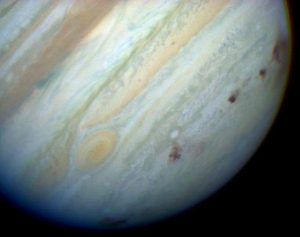
main-qimg-1e3b60f1af94711de6ed99830fc9e33a-cDark areas on Jupiter where Comet Shoemaker-Levy 9 hit.

It is true that I am not an expert on comet dynamics, but I know how to read and understand the scientific literature.  I am going to presume that Napier misunderstood my position and that although he may disagree with Holliday et al., my statements were based on their refereed scientific article.  In fact, Holliday et al. challenge Napier et al.[4] in their paper for suggesting that “passage through a cluster of fragments from a broken comet would probably ‘yield several impactors with energies up to 5,000 megatons, fully adequate for surface melting’… However, cometary impactors of this energy would be about 1 km in diameter and there is no physical mechanism to prevent them from striking the ground and forming 10-km diameter craters.”  Of course, I also addressed the lack of craters at the YD boundary when I was on the JRE.  I would only add that Napier might be better served by addressing Holliday et al. and other scientists directly involved with the YDIH in the scientific literature as opposed to publishing letters in the Cosmic Tusk – a site that clearly appeals to a nonscientific audience interested in the speculative and supernatural.

It does not appear that Napier had a hidden agenda in criticizing me, but I wish I could say the same for Howard.  His comments are characteristic of some of the vitriol I received from the general public for simply disagreeing with Hancock – not the kind of professionalism one might expect from a person who lauds himself as a scientist (and skeptic of all things).  I honestly think it is unbefitting of me to address ad hominem and sarcastic attacks like “Defant showed zero humility and spoke of comets with the familiarity of a volcanologist.”  However, I do think it is instructive for my students to see that “scientists” are human and sometimes resort to personal attacks rather than addressing the details of the science.   Basically Howard is engaging in silly turf wars where credentials and opinion of behavior become more important than the scientific rigor of what is being said.  As far as I can tell, Howard has a BA degree in political science from the University of North Carolina so I am not sure he should be throwing rocks from his proverbial glass house.  One wonders how he can make the claim that “He may or may not know it, but Defant’s received wisdom… is 1960’s [sic] grade school comet science [sic]” (I refer the reader to my discussion above in refutation of the few actual scientific criticisms Howard makes – basically a repeat of what Napier says).

Walter Alvarez, a structural geologist, and his father Luis Alvarez, a physicist (passed), were responsible for discovering the impact of a 10 km meteorite that hit earth 66 million years ago and led to the eventual extinction of the dinosaurs.  I wonder if Howard dismisses their discovery because they were not astronomers?  Two geochemists also participated in the discovery which is my specialty (I am a professor of geochemistry and my PhD is specifically in that field) – I apply geochemistry to volcanic rocks to understand processes within the earth.  Had Howard taken the time to research my background before he made his attacks, he would have found my book Voyage of Discovery: From the Big Bang to the Ice Age (about the history of the universe, earth and life), my general science course entitled Origins, my video lectures particularly on astronomy (including comets), and my Tedx talk on Why We are Alone in the Galaxy as some evidence that I might know a bit more about the subject than “grade school comet science”.  I note that Howard’s contention in the Firestone et al.[5] paper that the formation of the Carolina Bays (his claimed area of research) by comet strikes 12,900 years ago has been thoroughly debunked based on new dating[6].  It would be unprofessional on my part to attribute his incorrect interpretation of the Carolina Bays to a lack of understanding because he is a political scientist, so I won’t.

I find it ironic that Howard claims to be a skeptic and yet publishes (and links) to a paper by Hancock who, among other things, touts his lost civilization: Hancock on the Younger Dryas Impact Hypothesis since 2007.  Let’s not forget that Hancock claims that we are in mortal danger until 2040 from another comet strike based on interpretations he makes from so-called asterisms at Glöbekli Tepe.  Apparently Hancock, a self-described reporter with an undergraduate degree in sociology (see the JRE starting at about 2:12:47 where we are discussing the Mayan calendar – he claims to be just a reporter) has more bonafides than a “volcanologist” in Howard’s mind.  Hancock’s credentials notwithstanding, I hardly think Howard can consider himself a skeptic when he allows someone to tout fantastic unsupported stories about lost civilizations on his website.  I presume the Cosmic Tusk is more interested in giving a voice to people who agree with Howard, regardless of their far-fetched notions about the supernatual, than scientists interested in physical reality.


[1] Firestone, R. B., et al., 2007. Evidence for an extraterrestrial impact 12,900 years ago that contributed to the megafaunal extinctions and the Younger Dryas cooling. Proc. Natl. Acad. Sci., v. 104, 16016-16021.

[2] Holliday, V. T., et la., 2014. The Younger Dryas impact hypothesis: a cosmic catastrophe. J. Quaternary Sci., v. 29, 515-530.

[3] Wittke, J. H., et al., 2013, Evidence for deposition of 10 million tonnes of impact spherules across four continents 12,800 years ago: Proc. Natl. Acad. Sci., v. 110, p. E2088-E2097

[4] Napier, W.A., et al., 2013, Reply to Boslough et al.: Decades of comet research counter their claims: Proc. Natl. Acad. Sci., v. 110, p. E4171.

[5] Firestone et al., 2007,  op cit.

[6] For example, Meltzer, D. J. et al., 2014, Chronological evidence fails to support claims for an isochronus widespread layer of cosmic impact indicators dated to 12,800 years ago: Proc. Natl. Acad. Sci., v. 111, p. E2162-E2171.
My article entitled Conjuring Up a Lost Civilization: An Analysis of the Claims Made by Graham Hancock in Magicians of the Gods[1] was published in Skeptic magazine on Sept. 14, 2017   It has been an interesting road to the final publication.  Michael Shermer (editor of Skeptic magazine) asked me to join him on the Joe Rogan Experience podcast #961 and Youtube video cast (JRE) in a debate with Graham Hancock and geologist Randal Carlson which I have linked (Hancock invited planetary scientist Malcolm LeCompte).  The three and half hour podcast has had millions of views on various platforms including 1.4 million on Youtube.  According to Shermer in an accompanying article in Skeptic, during the week of the show it was downloaded 120 million times “putting him [Rogan] on par with the biggest talk show hosts on television” and making our podcast one of the most popular in the world (I became involved in the debate at 2:04:45).

Rogan is normally a neutral host based on what I have seen of some of his earlier shows, but that was certainly not the case in this podcast.  The early sections of the show pitted Rogan, Hancock, and Carlson against Shermer as he tried to defend our skepticism toward Hancock’s book.   I will let Shermer’s words in his article stand without further comment.

Shermer writes a monthly article for Scientific American.  By sheer coincidence, his article on Hancock’s book was posted the day of the podcast.   Shermer muses in his Skeptic article about how Hancock wrote him after the podcast vociferously objecting  to “the rubbishing of his life’s work” in the Scientific American article.  Shermer explains that he is truly sorry that Hancock felt personally attacked and that was not his intention.  I was also the brunt of Hancock’s outrage over my skepticism about the contentions he makes in his book.  I posted an early version of the article here on my blog — I use my blog primarily as a way to show students how science and logic can be used to address controversial claims in various fields (e.g., GMOs, fracking, global warming, etc.).  The original article had many editorial changes but due to copyright precedence by Skeptic I only showed the original article submitted.  Prior to the JRE podcast, Hancock found the original article and became visibly angry during the podcast over what I had written (I do not wish to inflame him further by asserting that he was angry but Hancock used the word angry on Facebook after the podcast: “Judging from the Youtube comments to my recent appearance on the JRE I have been transformed into a hate figure because I expressed anger at the article posted online in January 2017 by Marc Defant”).  Like Shermer, I had no intention of personally attacking Hancock and was apologetic that he misunderstood my intentions when I first came on the podcast.  I cannot speak for Shermer but I think skeptics, myself included, are somewhat befuddled by the acceptance of non-scientific claims by many in the general population.  Hancock’s book  is an international bestseller and will continue to influence uncritical minds for generations.  People like Carl Sagan and James Randi started taking people to task in the 1970s for making outrageous and unfounded claims (e.g., Erich von Däniken and his alien visitation scenario) which eventually led to the formation of skeptic societies.  The goal is not to personally attack anyone but to demonstrate how faulty some of the more fantastic claims are.  I deeply support Hancock’s right to his opinion, but as scientists, I believe we have a duty to dispute fantasy that masquerades as scientific inquiry — for example, von Däniken’s books.

I need to identify some misunderstanding which Hancock has taken full advantage of, and I have been unable to comment about while I waited for the publication of my paper by Skeptic magazine.   After the podcast, Shermer asked me to remove my blog post on Hancock because, obviously, he wanted people to read the article in Skeptic.  I readily agreed to remove the article.  In a weird twist, Hancock and many of the viewers of the podcast insisted that this demonstrated that I had made claims in the blog that were incorrect.  That is not true.  As I stated in the podcast, I stand by the claims I made about his book both on the podcast and in the Skeptic paper.  In fact, I elaborated on what I said on the JRE in my Skeptic article and have added additional comments below that were not in the magazine article.  My original revised paper after the JRE was so long Skeptic had to cut some of my arguments to avoid a book-size article.   Consequently, I elaborate below on several of the topics not addressed in the Skeptic paper particularly because I never got a chance to express them in detail on the JRE.


The gravity of the situation

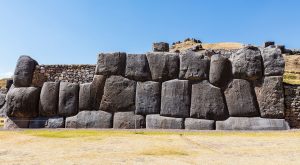
In Hancock’s discussion of the  Incan archaeological site Sacsayhuaman in Peru, he recounts how he was guided around the ruins by some mystic named Jesus Gamarra, who thinks that the finely crafted rocks at the site were not done by the Incas but by ancient people in a time when “gravity was lower” so the huge blocks could be moved more easily. I would not pay much attention to this unscientific remark other than to make note of Hancock’s astonishing comment about this “theory”: “The lowered gravity is linked in his mind [Gamarra] with the notion that the earth once made much closer orbits around the sun—an orbit of 225 days and an orbit of 260 days—before settling in to its present 365 day path. He could be right [my emphasis]; new science suggests that the orbits of the planets are not fixed and stable.” Hancock does not seem to realize that the gravitational pull on an object at the surface of the earth has practically nothing to do with the period of the orbit of the earth around the sun. How could Gamarra be right?  As Newton discovered in the 1600s, the gravitational pull between two objects, say the earth and a large rock, is directly related to the mass of the earth and the rock and the inverse of the square of their distance.

In fairness to Hancock I quote his remarks from the JRE: “He [referencing me] just presents me as buying what Jesus Gamara says.  If that’s the standard that you are going to have in Skeptic magazine you have a serious problem…I do say he [Gamarra] may be right, but I don’t say he is right.  I say this is not my interest.”  I attempted to explain that my focus was not on whether he agreed with Gamarra but on his statement that rocks might not be as heavy in the past because the “period of the orbit of the earth around the sun” changed.  He completely deflected away from my contention that changing the orbit around the sun has virtually nothing to do with how heavy rocks might be on earth.  I believe the misunderstanding of the basic laws of gravity is important – it makes him suspect on other grandiose contentions he makes concerning science.

Sacsayhuamán,_Cusco,_Perú,_2015-07-31,_DD_27The superb construction at Sacsayhuaman in Peru.
I have attempted to see if the statement could be read any differently (he skated around the issue in the debate), but I fail to understand how. Hancock states that Gamara may be correct in his contention that the rocks were lighter in the past because the orbit of the earth around the sun may have been 225 days (or 260 days). Instead of pointing out that a 225-day orbit around the sun in 900 AD when Sacsayhuaman was built seems silly (calendars have been around for more than 2000 years continuously demonstrating 365-day years), Hancock states “he may be right”.  He may be right that the earth in 900 AD was where the orbit of Venus is now?  But even if the earth in some mystical way was on a 225-day orbit a quick back of the envelop calculation using Newton’s equation of gravity demonstrates that the weight of a rock on earth will not be significantly impacted by the gravitational pull of the sun.


Moai and Easter Island

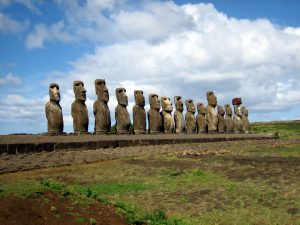
During the JRE, Shermer brought up the moai, the megaliths on Easter Island.  More than 900 moai were sculpted between 1250 and 1500 AD, hauled to their present locations, and erected upright.  One of them weighs over 82 tons.  Many of the moai remain in the main quarry on the island – Rano Raraku. Hancock never addressed Shermer’s point that huge magaliths can be made by people with limited technological skills.  I later reemphasized to Hancock that the hunter gatherers on Easter Island had no problems constructing megaliths larger than those at Glöbekli Tepe with stone tools.  Why should we call upon the involvement of advanced civilizations?  But Hancock again deflected, surprised that I would suggest that hunter gatherers lived on Easter Island: “What’s there to hunt and gather on a tiny island – have you been to Easter Island? I have, six times, and you can walk across it in three hours.  What’s there to hunt and gather on that?”

AhuTongarikiMoai of Easter Island

Apparently what he did not realize is that when Polynesians (the Rapa Nui people) first arrived on Easter Island probably around 300 AD, the island was a lush tropical paradise.  Jared Diamond, in his book Collapse[2], proposed that the Rapa Nui hunter gatherers committed ecocide which led to the destruction of the island’s lush ecosystem and forced the Rapa Nui founders’ descendents to depend on a meager agriculture.  The increased population of the Rapa Nui on Easter Island according to Diamond led to deforestation and overkill of native species, decimating the ecosystem.  The point that Shermer and I were trying to emphasize is that hunter gatherers can make sophisticated megaliths without the help of “Magicians”.  Hancock postulates in his book that Magicians of the Gods were needed also at Easter Island.  No explanation has ever been given as to how these Magicians got to Easter Island or why but Hancock believes they were required to help the native population to construct the moai.

But alas, the argument is not specifically about the hunter gatherers on Easter Island.  It is about whether it takes an “advanced civilization” to create large hand-carved megaliths – hand carved with stone tools I might add!.  Not a single professional archaeologist working on Easter Island has ever suggested a requisite advanced civilization.   They all agree they were quarried locally with stone tools by the indigenous population[3].


The End of the World

In Hancock’s 1995 book Fingerprints of the Gods[4], Hancock suggests that the end of the world is approaching, all neatly summarized in a section at the end of his book entitled “The End of the World”. He particularly references December 23, 2012 (from the Mayan calendar) as a likely date for the end, but in Magicians he adroitly does not dwell on why these doomsday scenarios never came to be. He does an about face and tells us he never meant for these dates to be taken literally and sheepishly states in Magicians: “it is important to be clear that in signaling the decades around 2012 as the end of a great cycle, the Maya were not speaking of the end of the world, as such, but rather of the end of an age.”  I am reminded of Ghostbusters II when Peter Venkman (Bill Murray) is interviewing Milt Angland (Kevin Dunn) on his new book entitled The End of the World for Venkman’s television show World of Psychics.  When Angland announces that the end of the world will be on New Year’s Eve at midnight, Venkman astutely notes that choosing a date so close to the present is not wise for book sales.  After Angland gives a painful “fugue state” response as to why the date must be correct Venkman quips: “For your sake, I hope you’re right.”  My advice to Hancock — pick an end of the world date that does not occur in your lifetime!

In response to this early version of the article, Hancock posted the following comment in his defense on his Facebook page: “Are my views not allowed to evolve, then, or react to new information? Must I never stray from the line I took in a 1995 book? If I did so would that be ‘scientific’?”  Of course his views are allowed to change.  But predicting the end of the world from the Mayan calendar is not scientific.  One might expect that being wrong on such an important event as the end of the world would chasten him.  Not so!  After the end of the world did not occur in 2012, he continued down the same road making this comment in Magicians:

“It is possible, indeed highly probable, that we are not done with the comet that changed the face of the earth between 10,800 BC and 9600 BC.  To be quite clear,… some suspect that ‘the return of the Phoenix’ will take place in our own time — indeed by or before the year 2040 — and there is danger that one of the objects in its debris stream may be as much as 30 kilometers (18.6 miles) in diameter.  A collision with such a large cometary fragment would, at the very least, mean the end of civilization as we know it, and perhaps even the end of all human life on this planet.  Its consequences would be orders of magnitude more devastating than the Younger Dryas impacts 12,800 years ago that left us as a species with amnesia, obliged to begin again like children with no memory of what went before.”

First Hancock assumes that a comet struck about 13,000 years ago – still a hotly debated research topic.  Second, as I discuss in my Skeptic article, he contends that the precession of the earth tells him that we will be struck by another large comet some time before 2040.  As I explained in Skeptic, precession has nothing to do with cyclical comet collisions.  Predicting the end of the world seems to fascinate his audience but where is the science?  It is complete speculation equivalent to soothsaying (I suspect that this will irritate Hancock but I want those that are willing to listen to know that predicting the end of the world through speculation has nothing to do with science – nothing personal here).


[1] Hancock, G., 2015. Magicians of the God: The Forgotten Wisdom of Earth’s Lost Civilization: St. Martin’s Press.

[2] Diamond, J., 2005, Collapse: How Societies Choose to Fail or Suceed: Viking Press, 592p.

[3] See for example Van Tilbug, J., 1994, Easter Island: Archaeology, Ecology and Culture, Smithsonion Institution Press, 191p.

[4] Hancock, G., 1995. Fingerprints of the Gods: The Evidence of Earth’s Lost Civilization: Three Rivers Press.